Thursday, December 31, 2009
Wednesday, December 30, 2009
Tuesday, December 29, 2009
Monday, December 28, 2009
Cost and Outcomes in US healthcare
We know the numbers but neither the causes nor the solution.
The recent Senate bill will not change this curve by much.
American Exceptionalism Strikes Again | Angry Bear
The recent Senate bill will not change this curve by much.
American Exceptionalism Strikes Again | Angry Bear
Stimulus timing - Paul Krugman Blog - NYTimes.com
Simple explanation of impact of stimulus on growth.
First derivative is important.
Stimulus timing - Paul Krugman Blog - NYTimes.com
First derivative is important.
Stimulus timing - Paul Krugman Blog - NYTimes.com
Jonathan Gruber - 'Cadillac' tax isn't a tax -- it's a plan to finance real health reform - washingtonpost.com
A lesson in framing.
The Cadillac tax is not a tax. It is actually an elimination of a tax break on wealthy Americans.
Jonathan Gruber - 'Cadillac' tax isn't a tax -- it's a plan to finance real health reform - washingtonpost.com
The Cadillac tax is not a tax. It is actually an elimination of a tax break on wealthy Americans.
Jonathan Gruber - 'Cadillac' tax isn't a tax -- it's a plan to finance real health reform - washingtonpost.com
“Is Blaming AAA Investors Wall-Street Serving PR?” « naked capitalism
Investment Banks ripped off investors by selling them fraudulently marked bonds.
“Is Blaming AAA Investors Wall-Street Serving PR?” « naked capitalism
“Is Blaming AAA Investors Wall-Street Serving PR?” « naked capitalism
Sunday, December 27, 2009
Saturday, December 19, 2009
Thursday, December 17, 2009
Morgan Stanley Walking Away from Properties
First class business in a first class way.
What does this say about the CRE market?
What if more homeowners start to do this? Another leg down in the housing market.
What does this say about the CRE market?
What if more homeowners start to do this? Another leg down in the housing market.
Wednesday, December 16, 2009
Bonuses Were Paid Fraudulently
Trader and management bonuses were based on fraudulent profits and should be clawed back.
Unfortunately this will not happen.
This is another good reason for a windfall profit tax.
Former Barclays Chief Points Out Bonuses Were Paid Fraudulently « naked capitalism
Unfortunately this will not happen.
This is another good reason for a windfall profit tax.
Former Barclays Chief Points Out Bonuses Were Paid Fraudulently « naked capitalism
Sunday, December 13, 2009
The Secret Diary of Steve Jobs :
One of the problems of American industry. Lack of vision and run by the numbers mentality.
The Secret Diary of Steve Jobs : A not-so-brief chat with Randall Stephenson of AT&T
The Secret Diary of Steve Jobs : A not-so-brief chat with Randall Stephenson of AT&T
Saturday, December 12, 2009
FT.com | Money Supply | A windfall tax in the US?
The tax should be on bank's profits, not on the bonuses. This is easier to administer and tougher to defer. Less appealing to vindictive popularists.
FT.com | Money Supply | A windfall tax in the US?
FT.com | Money Supply | A windfall tax in the US?
Obama's Big Sellout : Rolling Stone
More on America's Oligarchy from Taibbi.
Obama's Big Sellout : Rolling Stone
DeLong counters.
And a counter.
And Salmon counters the counter.
Obama's Big Sellout : Rolling Stone
DeLong counters.
And a counter.
And Salmon counters the counter.
Friday, December 11, 2009
Thursday, December 10, 2009
Wednesday, December 09, 2009
Britain to Levy a One-Time Tax on Banker Bonuses - NYTimes.com
U.K. shows guts. Unfortunately this will not happen in the US. It should
Britain to Levy a One-Time Tax on Banker Bonuses - NYTimes.com
Britain to Levy a One-Time Tax on Banker Bonuses - NYTimes.com
What is Maturity - and Who's Got It?,
From the comments: "It's accepting that there are some things you want but will never have, and that that's ok."
What is Maturity - and Who's Got It?, Bryan Caplan | EconLog | Library of Economics and Liberty: "
What is Maturity - and Who's Got It?, Bryan Caplan | EconLog | Library of Economics and Liberty: "
Monday, December 07, 2009
NY Fed President Dudley: Still More Lessons from the Crisis
The Fed is learning. They are no longer saying that they will wait for bubbles to pop and then clean them up.
Calculated Risk: NY Fed President Dudley: Still More Lessons from the Crisis
Calculated Risk: NY Fed President Dudley: Still More Lessons from the Crisis
Sunday, December 06, 2009
Fundamental Reseaons for the Gold Bubble
Rational explanations of the irrational.
The Oil Drum: Europe | Peak Gold, Easier to Model than Peak Oil? - Part I
The Oil Drum: Europe | Peak Gold, Easier to Model than Peak Oil? - Part I
Friday, December 04, 2009
For my Netflix queue
I got lots of free time these days.
f250bestmoviesmap_HQ.jpg (JPEG Image, 3507x2160 pixels) - Scaled (43%)
f250bestmoviesmap_HQ.jpg (JPEG Image, 3507x2160 pixels) - Scaled (43%)
Thursday, December 03, 2009
Public Works
But it's not as though the United States hasn't started some big public works projects over the past decade or so; it just hasn't been doing them here at home. We've spent billions constructing military bases in Iraq and Afghanistan, for example, and another billion or more on a giant embassy in Baghdad and another one in Pakistan. Needless to say, those "public works" projects are a drain on the U.S. economy rather than a source of additional productivity.
Obsidian Wings: But I’ve Been Unfaithful, I’ve Been Traveling Abroad
Obsidian Wings: But I’ve Been Unfaithful, I’ve Been Traveling Abroad
Wednesday, December 02, 2009
A More Perfect Union
"What would a better marriage look like? More happiness? Intimacy? Stability? Laughter? Fewer fights? A smoother partnership? More intriguing conversation? More excellent sex?"
A More Perfect Union - NYTimes.com
A More Perfect Union - NYTimes.com
Contra Max Weber
So the most value I got out of that sociology class was the 9w joke.
Marginal Revolution: Contra Max Weber
Marginal Revolution: Contra Max Weber
Tuesday, December 01, 2009
The Amazing Animated Version Of The Tiger Woods Crash
The Chinese are really taking over the world. They have surveillance cameras in Orlando
The Amazing Animated Version Of The Tiger Woods Crash
The Amazing Animated Version Of The Tiger Woods Crash
Monday, November 30, 2009
Saturday, November 28, 2009
Time to Stick the Knife In
Markets are good at telling you the current price of things. They are not good at forecasting the future. Non market participants often misinterpret this.
Financial Armageddon: Time to Stick the Knife In
Financial Armageddon: Time to Stick the Knife In
"Independent Does Not Mean Unaccountable"
Thoma channels Bernanke who is defending the Fed against those who would strip it of powers.
He admits the Fed "did not do all that it could have to constrain excessive risk-taking in the financial sector in the period leading up to the crisis."
Economist's View: "Independent Does Not Mean Unaccountable"
Dean Baker is not impressed.
Nor is Naked Capitalism
He admits the Fed "did not do all that it could have to constrain excessive risk-taking in the financial sector in the period leading up to the crisis."
Economist's View: "Independent Does Not Mean Unaccountable"
Dean Baker is not impressed.
Nor is Naked Capitalism
Thursday, November 26, 2009
How Little We Know
Money Quote
"A Martian impartially observing the U.S. financial
system would conclude that it is run to
benefit the executives and protégés of Goldman
Sachs."
Greg Mankiw's Blog: How Little We Know
"A Martian impartially observing the U.S. financial
system would conclude that it is run to
benefit the executives and protégés of Goldman
Sachs."
Greg Mankiw's Blog: How Little We Know
Yes, Fox News Really Is This Bad
They cannot get the math right
Yes, Fox News Really Is This Bad! - J. Bradford DeLong's Grasping Reality with All Eight Tentacles
Nor can they get history correct.
Or is this worse.?
Yes, Fox News Really Is This Bad! - J. Bradford DeLong's Grasping Reality with All Eight Tentacles
Nor can they get history correct.
Or is this worse.?
Wednesday, November 25, 2009
Dating sites use DNA to find your perfect match
Could be another misuse of science.
Dating sites use DNA to find your perfect match
Dating sites use DNA to find your perfect match
Tuesday, November 24, 2009
Highways Are Heavily Subsidized
An important fact that is left out of the debate about building a decent high speed rail and urban mass transit is that both highways and air travel are heavily subsidized.
Matthew Yglesias » Highways Are Heavily Subsidized
Matthew Yglesias » Highways Are Heavily Subsidized
Troop Levels in Afganistan
It is hard to imagine that 40,000 additional troops will lead to a positive outcome.
Chart Of The Day II - The Daily Dish | By Andrew Sullivan
Chart Of The Day II - The Daily Dish | By Andrew Sullivan
Price Discrimination
An explanation of Black Friday. I am staying away.
Price Discrimination Explains Everything, Arnold Kling | EconLog | Library of Economics and Liberty
Price Discrimination Explains Everything, Arnold Kling | EconLog | Library of Economics and Liberty
Greg Mankiw's Blog: Healthcare Reform and the Big Tradeoff
Mankiw provides a link to a Federal Reserve Bank of Minneapolis 2004 paper that explains why Americans work harder than Europeans. I am not convinced that it is all about taxes.
Greg Mankiw's Blog: Healthcare Reform and the Big Tradeoff
Greg Mankiw's Blog: Healthcare Reform and the Big Tradeoff
Sunday, November 22, 2009
Friday, November 20, 2009
Thursday, November 19, 2009
Wednesday, November 18, 2009
The Mythology of the Future Job Market ~ Angry Bear
A pessimistic look at the future of employment.
The Mythology of the Future Job Market ~ Angry Bear
and here.
The Mythology of the Future Job Market ~ Angry Bear
and here.
Tuesday, November 17, 2009
Economics of Contempt: Geithner Vindicated in TARP Watchdog Report
A more nuanced view of the AIG bailout. The FED had no power to get less than par value from the banks. Any power it would have would be the threat of regulatory retaliation.
Economics of Contempt: Geithner Vindicated in TARP Watchdog Report
Economics of Contempt: Geithner Vindicated in TARP Watchdog Report
“Should America Kowtow to China?” « naked capitalism
Best advice on the dollar: "Do nothing". It will not fall dramatically from here because China needs the job machine
and even if it does that is not a problem,
“Should America Kowtow to China?” « naked capitalism
and even if it does that is not a problem,
“Should America Kowtow to China?” « naked capitalism
Monday, November 16, 2009
Sunday, November 15, 2009
Matthew Yglesias » Broder on Afghanistan: Better a Quick Choice Than the Right One
The problem with the right wing is that many thing this way
"Given that reality, the urgent necessity is to make a decision -- whether or not it is right."
Usually they would not be honest enough to admit that fact.
Matthew Yglesias » Broder on Afghanistan: Better a Quick Choice Than the Right One
"Given that reality, the urgent necessity is to make a decision -- whether or not it is right."
Usually they would not be honest enough to admit that fact.
Matthew Yglesias » Broder on Afghanistan: Better a Quick Choice Than the Right One
The All-Inclusive All-You-Can-Eat Buffet Guide « Eating The Road
An American classic: The all you can eat buffet. I prefer the Chinese.
The All-Inclusive All-You-Can-Eat Buffet Guide « Eating The Road
The All-Inclusive All-You-Can-Eat Buffet Guide « Eating The Road
Ayn Rand: The Boring Bitch is Back | The Big Picture
Good news: not every hedge fund manager is Randian.
Ayn Rand: The Boring Bitch is Back | The Big Picture
Ayn Rand: The Boring Bitch is Back | The Big Picture
Japan as No. 1
Thirty years later. Vogel had a point. Just the title was wrong.
A more competitive America, he says, needs a much stronger government, an elite civil service composed of “the ablest young people of their generation” and a White House staffed by these new mandarins. Moral pressure needs to be felt again by Americans to bind their fragmented society together. “In the guise of pursuing freedoms, we have supported egoism and self-interest and have damaged group or common interests...we are more concerned with the rights of the deviant than the rights of the responsible citizen.
"
From the archive: One side of the success story | The Economist
A more competitive America, he says, needs a much stronger government, an elite civil service composed of “the ablest young people of their generation” and a White House staffed by these new mandarins. Moral pressure needs to be felt again by Americans to bind their fragmented society together. “In the guise of pursuing freedoms, we have supported egoism and self-interest and have damaged group or common interests...we are more concerned with the rights of the deviant than the rights of the responsible citizen.
"
From the archive: One side of the success story | The Economist
Saturday, November 14, 2009
The Right and Terrorists.
"This is literally true: the Right's reaction to yesterday's announcement -- we're too afraid to allow trials and due process in our country -- is the textbook definition of "surrendering to terrorists." It's the same fear they've been spewing for years. As always, the Right's tough-guy leaders wallow in a combination of pitiful fear and cynical manipulation of the fear of their followers. Indeed, it's hard to find any group of people on the globe who exude this sort of weakness and fear more than the American Right."
Glenn Greenwald - Salon.com
Glenn Greenwald - Salon.com
Thursday, November 12, 2009
Saturday, November 07, 2009
U6
NY Times: Unemployment Measure U-6 Highest Since Great Depression
From David Leonhardt at the NY Times: Broader Measure of Unemployment Stands at 17.5% Excerpts:Officially, the Labor Department’s broad measure of unemployment goes back only to 1994. But early this year, with the help of economists at the department, The New York Times created a version that estimates it going back to 1970.There is much more in the article, but this suggest that the BLS' "Alternative measure of labor underutilization U-6"1 is now at the highest level since the Great Depression.
...
If statistics went back so far, the measure would almost certainly be at its highest level since the Great Depression.
In all, more than one out of every six workers — 17.5 percent — were unemployed or underemployed in October. The previous high was 17.1 percent, in December 1982.
1 "Total unemployed, plus all marginally attached workers plus total employed part time for economic reasons, as a percent of all civilian labor force plus all marginally attached workers"
Thursday, November 05, 2009
On second thought?
Three cheer for college football towns - Nov. 5, 2009
11 Penn State University State College, Pa. $ 309,850 97
On Invoking God to Defend Mammon
Mark you this, Bassanio,
The devil can cite Scripture for his purpose.
An evil soul producing holy witness
Is like a villain with a smiling cheek,
A goodly apple rotten at the heart:
O, what a goodly outside falsehood hath!
On Invoking God to Defend Mammon « naked capitalism
The devil can cite Scripture for his purpose.
An evil soul producing holy witness
Is like a villain with a smiling cheek,
A goodly apple rotten at the heart:
O, what a goodly outside falsehood hath!
On Invoking God to Defend Mammon « naked capitalism
Sympathy for the Treasury
Interesting take. What is the difference between interpersonal relationships and corruption?
Interfluidity :: Sympathy for the Treasury
This also contains hints about how to handle small group meetings with people of disparate backgrounds and how not to answer questions. How does Treasury teach these skills?
Interfluidity :: Sympathy for the Treasury
This also contains hints about how to handle small group meetings with people of disparate backgrounds and how not to answer questions. How does Treasury teach these skills?
Wednesday, November 04, 2009
The Hubris of Economics |
Economics forgot George E. P. Box’s most basic rule:
“Essentially, all models are wrong, but some are useful”
The Hubris of Economics | The Big Picture
Tuesday, November 03, 2009
Reconstruction for the USA
We need to be more vocal about this. Defense spending is a long term threat to the national interests of the United States. Why is there not more talk about cost benefit analysis.
Matthew Yglesias » Reconstruction for the USA
Matthew Yglesias » Reconstruction for the USA
Sunday, November 01, 2009
Saturday, October 31, 2009
Where Did the Bush Tax Cuts Go?
The issue is who we are and what we want to be. A lot of the comments concern the fact that of course most of the tax cuts go to the top one percent because they pay the most taxes. The real point should is whether the tax system should be progressive or not. The tax cuts to the top 1% did not have to happen.
Economist's View: Where Did the Bush Tax Cuts Go?
Economist's View: Where Did the Bush Tax Cuts Go?
Why do other countries care more about health care cost control?
The difference in spending is so great and the difference in outcome is so small that it is really hard to understand why we tolerate spending more.
Marginal Revolution: Why do other countries care more about health care cost control?
Marginal Revolution: Why do other countries care more about health care cost control?
Wednesday, October 28, 2009
The puzzle of private equity
It is still not clear if private equity adds value to anyone but the private equity managers.
The puzzle of private equity | Buttonwood's notebook | Economist.com
The puzzle of private equity | Buttonwood's notebook | Economist.com
Tuesday, October 27, 2009
Solar Energy
How many panels would be required to power the world?
The answer is simple the logistics of building panels and grid are daunting.
Also there is the problem of night.
AreaRequired1000.jpg (JPEG Image, 1000x706 pixels)
The answer is simple the logistics of building panels and grid are daunting.
Also there is the problem of night.
AreaRequired1000.jpg (JPEG Image, 1000x706 pixels)
Chinese growth looking strong
Chinese growth is 9 percent. But the stimulus measures account for 15 percent of GDP.
Chinese growth looking strong | Free exchange | Economist.com
And pig farmers are buying up copper.
Chinese growth looking strong | Free exchange | Economist.com
And pig farmers are buying up copper.
Monday, October 26, 2009
Wednesday, October 21, 2009
Glass Steagall
Why Volcker is wrong and you cannot return to a world of commercial and investment banks.
Paul Volcker, Mervyn King, Glass Steagall, and the Real TBTF Problem « naked capitalism
Paul Volcker, Mervyn King, Glass Steagall, and the Real TBTF Problem « naked capitalism
Tuesday, October 20, 2009
AllAboutAlpha.com» Featured Post » Fisheries, tipping points, and disease “super-spreaders” in Boston
Global Absolute Return Conference
AllAboutAlpha.com» Featured Post » Fisheries, tipping points, and disease “super-spreaders” in Boston
http://www.global-arc.net/
AllAboutAlpha.com» Featured Post » Fisheries, tipping points, and disease “super-spreaders” in Boston
http://www.global-arc.net/
The Sun That Rises On Shanghai Sets On Tokyo « China Bystander
Tokyo and Japan are losing their place in Asia.
The Sun That Rises On Shanghai Sets On Tokyo « China Bystander
The Sun That Rises On Shanghai Sets On Tokyo « China Bystander
Monday, October 19, 2009
Governments Should Tax Bank Bonuses - WSJ.com
The WSJ is demanding social justice and denying the supremacy of markets.
The gall of the investment banks and banks is too much even for them.
Governments Should Tax Bank Bonuses - WSJ.com
The gall of the investment banks and banks is too much even for them.
Governments Should Tax Bank Bonuses - WSJ.com
Securitized Loans Are 5X More Likely to Be Delinquent | The Big Picture
A nice visual of the securitization process.
Securitized Loans Are 5X More Likely to Be Delinquent | The Big Picture
Securitized Loans Are 5X More Likely to Be Delinquent | The Big Picture
*Sigh* Last Post on Superfreakonomics, I Promise - J. Bradford DeLong's Grasping Reality with All Eight Tentacles
If you are going to get Brad DeLong to review your book, make sure it is before your final draft. DeLong rips Levitt and Dubner:
*Sigh* Last Post on Superfreakonomics, I Promise - J. Bradford DeLong's Grasping Reality with All Eight Tentacles
*Sigh* Last Post on Superfreakonomics, I Promise - J. Bradford DeLong's Grasping Reality with All Eight Tentacles
Friday, October 16, 2009
Just when you thought things were getting better.
The white house comment:
A White House spokesman, asked about the case, quipped: “I’ve found that, actually, the children of biracial couples can do pretty good.”
Louisiana Justice of the Peace Denies Marriage License to Interracial Couple - Associated Content - associatedcontent.com
Not the pride of Harvard Class '83.
http://tpmlivewire.talkingpointsmemo.com/2009/10/vitter-refuses-to-comment-on-justice-who-wont-marry-interracial-couples.php
A White House spokesman, asked about the case, quipped: “I’ve found that, actually, the children of biracial couples can do pretty good.”
Louisiana Justice of the Peace Denies Marriage License to Interracial Couple - Associated Content - associatedcontent.com
Not the pride of Harvard Class '83.
http://tpmlivewire.talkingpointsmemo.com/2009/10/vitter-refuses-to-comment-on-justice-who-wont-marry-interracial-couples.php
Thursday, October 15, 2009
Wednesday, October 14, 2009
And I thought it was kinda pretty...

"In South Kent, about 13 miles into the trip, we stopped to examine the covered bridge at Kent Falls, which was gray and unadorned and paved with cement. It was, I’m guessing, the least exciting covered bridge in the world."
NYT travel
Tuesday, October 13, 2009
Vernon Smith on Elinor Ostrom
On Nobel prize winner Elinor Ostrom.
The commons are not always tragic.
Marginal Revolution: Vernon Smith on Elinor Ostrom
The commons are not always tragic.
Marginal Revolution: Vernon Smith on Elinor Ostrom
Cost Cuts Lift Profits but Hinder Economy - WSJ.com
"Things are better, but compared to what"
How will the economy grow with private net investment at -0.1 percent of gdp?
Cost Cuts Lift Profits but Hinder Economy - WSJ.com
How will the economy grow with private net investment at -0.1 percent of gdp?
Cost Cuts Lift Profits but Hinder Economy - WSJ.com
Monday, October 12, 2009
The Root Causes of Divorce:
Add another one:
"Increase in opportunity cost of maintaining marriage".
The Root Causes of Divorce: The Usual Suspects, Bryan Caplan | EconLog | Library of Economics and Liberty
"Increase in opportunity cost of maintaining marriage".
The Root Causes of Divorce: The Usual Suspects, Bryan Caplan | EconLog | Library of Economics and Liberty
Saturday, October 10, 2009
The Problem with Economics
Much of economic papers in behavioral science are "awful amateur-hour sociology".
D-squared Digest -- FOR bigger pies and shorter hours and AGAINST more or less everything else
D-squared Digest -- FOR bigger pies and shorter hours and AGAINST more or less everything else
Rebuilding employment
The most important economic problem facing the US today: how to grow jobs.There are only three ways to do it:
to expand employment in existing companies, to stimulate the creation of new businesses, and to recruit relocation of existing businesses from other regions.
UnderstandingSociety: Rebuilding employment
But the room for policy is not clear. The best, but long term effort, is to increase the number of highly educated employees in the area.
"The goal of increasing the percentage of baccalaureate-level adults in a region is a crucial element of our future economic success"
to expand employment in existing companies, to stimulate the creation of new businesses, and to recruit relocation of existing businesses from other regions.
UnderstandingSociety: Rebuilding employment
But the room for policy is not clear. The best, but long term effort, is to increase the number of highly educated employees in the area.
"The goal of increasing the percentage of baccalaureate-level adults in a region is a crucial element of our future economic success"
A CRE News Summary
Vacancy in commercial is growing. This means that banks will be forced to take another round of writedowns. Are they ready for it?
Calculated Risk: A CRE News Summary
Calculated Risk: A CRE News Summary
Friday, October 09, 2009
WeeklyClaimsOct8
People are saying that this is a good number?
Still a lot of job losses compared to normal times.
WeeklyClaimsOct8.jpg (image)
Still a lot of job losses compared to normal times.
WeeklyClaimsOct8.jpg (image)
Thursday, October 08, 2009
Outsourcing
Why outsourcing is good for the average worker.
More American Workers Outsourcing Own Jobs Overseas | The Onion - America's Finest News Source
More American Workers Outsourcing Own Jobs Overseas | The Onion - America's Finest News Source
Strip Mall Vacancy Rate Hits 10.3%, Highest Since 1992
Jim the Realtor is obviously not looking at commercial. Disconnect now between resi and commercial
Calculated Risk: Reis: Strip Mall Vacancy Rate Hits 10.3%, Highest Since 1992
Calculated Risk: Reis: Strip Mall Vacancy Rate Hits 10.3%, Highest Since 1992
"No shortage of buyers"
Jim the Realtor turns bullish.
But the question is whether the tax credit is the impetus or is there pure demand.
Jim thinks that the demand is real.
Calculated Risk: Jim the Realtor: "No shortage of buyers"
But the question is whether the tax credit is the impetus or is there pure demand.
Jim thinks that the demand is real.
Calculated Risk: Jim the Realtor: "No shortage of buyers"
Wednesday, October 07, 2009
Fed Worries about CRE Grow
The next shoe to drop. Although it seems that much of this is already priced in the market, banks will have another round of bad earnings related to CRE. Vacancy rates reached 16%.
Calculated Risk: Fed Worries about CRE Grow
Calculated Risk: Fed Worries about CRE Grow
Sunday, October 04, 2009
Wednesday, September 30, 2009
Progress
Change in car safety has been dramatic since 1950. Remember that when wingnuts call for government to get off of their backs.
Marginal Revolution: Progress
Marginal Revolution: Progress
Sunday, September 27, 2009
Susquehanna
Profile of what makes a good trader. This could be about any one of the principals of quant trading firms by only changing a few details:
- Discipline
- Understanding of probability
- Willingness to take bets.
- Ability to lose money.
Philadelphia Magazine:
- Discipline
- Understanding of probability
- Willingness to take bets.
- Ability to lose money.
Philadelphia Magazine:
Wednesday, September 16, 2009
Tuesday, September 15, 2009
Monday, September 14, 2009
Saturday, September 12, 2009
Friday, September 11, 2009
Economist's View: "The Economic Impact of the American Recovery and Reinvestment Act of 2009"
Only 151 billion has been spent.
"As of the end of August, $151.4 billion of the original $787 billion has been outlaid or has gone to American taxpayers and businesses in the form of tax reductions"
Economist's View: "The Economic Impact of the American Recovery and Reinvestment Act of 2009"
"As of the end of August, $151.4 billion of the original $787 billion has been outlaid or has gone to American taxpayers and businesses in the form of tax reductions"
Economist's View: "The Economic Impact of the American Recovery and Reinvestment Act of 2009"
I know I know nothing;
Sometimes knowing what you do not know is a good thing.
FT.com | Willem Buiter's Maverecon | I know I know nothing; but at least I know that
FT.com | Willem Buiter's Maverecon | I know I know nothing; but at least I know that
Thursday, September 10, 2009
A brilliant healthcare speech
Should be watched in full.
Delivering a brilliant healthcare speech - Credit Writedowns
[Our predecessors] knew that when any government measure, no matter how carefully crafted or beneficial, is subject to scorn; when any efforts to help people in need are attacked as un-American; when facts and reason are thrown overboard and only timidity passes for wisdom, and we can no longer even engage in a civil conversation with each other over the things that truly matter – that at that point we don’t merely lose our capacity to solve big challenges. We lose something essential about ourselves.
That large-heartedness – that concern and regard for the plight of others – is not a partisan feeling. It is not a Republican or a Democratic feeling. It, too, is part of the American character. Our ability to stand in other people’s shoes. A recognition that we are all in this together; that when fortune turns against one of us, others are there to lend a helping hand. A belief that in this country, hard work and responsibility should be rewarded by some measure of security and fair play; and an acknowledgement that sometimes government has to step in to help deliver on that promise
Delivering a brilliant healthcare speech - Credit Writedowns
[Our predecessors] knew that when any government measure, no matter how carefully crafted or beneficial, is subject to scorn; when any efforts to help people in need are attacked as un-American; when facts and reason are thrown overboard and only timidity passes for wisdom, and we can no longer even engage in a civil conversation with each other over the things that truly matter – that at that point we don’t merely lose our capacity to solve big challenges. We lose something essential about ourselves.
That large-heartedness – that concern and regard for the plight of others – is not a partisan feeling. It is not a Republican or a Democratic feeling. It, too, is part of the American character. Our ability to stand in other people’s shoes. A recognition that we are all in this together; that when fortune turns against one of us, others are there to lend a helping hand. A belief that in this country, hard work and responsibility should be rewarded by some measure of security and fair play; and an acknowledgement that sometimes government has to step in to help deliver on that promise
Wednesday, September 09, 2009
Tuesday, September 08, 2009
The Evolution of Divorce
"now that the institutional model has lost its hold over the lives of American adults, sex, children, and intimacy can be had outside of marriage. All that remains unique to marriage today is the prospect of that high-quality emotional bond -- the soul-mate model. As a result, marriage is now disproportionately appealing to wealthier, better-educated couples, because less-educated, less-wealthy couples often do not have the emotional, social, and financial resources to enjoy a high-quality soul-mate marriage."
The Evolution of Divorce > Publications > National Affairs
The Evolution of Divorce > Publications > National Affairs
Monday, September 07, 2009
Total 10 Year Job Gains: Negative 203k |
More than housing, more than the deficit, this is the biggest problem facing our economy.
Total 10 Year Job Gains: Negative 203k | The Big Picture
Total 10 Year Job Gains: Negative 203k | The Big Picture
Sunday, September 06, 2009
Saturday, September 05, 2009
Friday, September 04, 2009
Broader Unemployment Rate Hits 16.8% in August - Real Time Economics - WSJ
U-6 is at record highs.
The index began in 1994.
Broader Unemployment Rate Hits 16.8% in August - Real Time Economics - WSJ
The index began in 1994.
Broader Unemployment Rate Hits 16.8% in August - Real Time Economics - WSJ
Thursday, September 03, 2009
Wednesday, September 02, 2009
Tuesday, September 01, 2009
Monday, August 31, 2009
Hpergamy
Another data point:
"Among the women, those with the greatest number of spouses were themselves considered high-quality mates, the hardest working..."
Marginal Revolution: Serial monogamy and hypergamous women
"Among the women, those with the greatest number of spouses were themselves considered high-quality mates, the hardest working..."
Marginal Revolution: Serial monogamy and hypergamous women
“The Savings Rate Has Recovered…if You Ignore the Bottom 99%” « naked capitalism
The top .01% of US (14,000 families) had a total savings of 171 billion. Half of all savings.
Stunning income distribution. And Republicans argue that slightly higher taxes will make these guys work less?
Guest Post: “The Savings Rate Has Recovered…if You Ignore the Bottom 99%” « naked capitalism
Stunning income distribution. And Republicans argue that slightly higher taxes will make these guys work less?
Guest Post: “The Savings Rate Has Recovered…if You Ignore the Bottom 99%” « naked capitalism
New evidence on international trade, offshoring, and US wages | vox - Research-based policy analysis and commentary from leading economists
This is a better interpretation than Krugman's "too soon to tell" explanation.
Less educated and lower wage US workers are hurt by globalization. The inverse is true for Chinese workers.
New evidence on international trade, offshoring, and US wages | vox - Research-based policy analysis and commentary from leading economists
Less educated and lower wage US workers are hurt by globalization. The inverse is true for Chinese workers.
New evidence on international trade, offshoring, and US wages | vox - Research-based policy analysis and commentary from leading economists
Saturday, August 29, 2009
Ted Kennedy: A Man in Full
Money quote:
"Whatever you think of Teddy's private morality, he is a publicly moral man."
RealClearPolitics - Ted Kennedy: A Man in Full
What he accomplished.
"Whatever you think of Teddy's private morality, he is a publicly moral man."
RealClearPolitics - Ted Kennedy: A Man in Full
What he accomplished.
Cross-Country Road Trip
It is not how you travel, it is who you travel with.
A Couple Takes a Cross-Country Road Trip by Van - NYTimes.com
A Couple Takes a Cross-Country Road Trip by Van - NYTimes.com
Friday, August 28, 2009
Financial Armageddon: A Member of the Delusional Set Slips Up
Finally people are starting to look at the real unemployment number:
U6.
Reality is that which, when you stop believing in it, doesn't go away.
Financial Armageddon: A Member of the Delusional Set Slips Up
U6.
Reality is that which, when you stop believing in it, doesn't go away.
Financial Armageddon: A Member of the Delusional Set Slips Up
Thursday, August 27, 2009
More Parent-Child Quality Time? Thank Harvard - Economix Blog - NYTimes.com
Why are you spending so much time with your kids?
Early on I decided mine were not going to Harvard.
More Parent-Child Quality Time? Thank Harvard - Economix Blog - NYTimes.com
Early on I decided mine were not going to Harvard.
More Parent-Child Quality Time? Thank Harvard - Economix Blog - NYTimes.com
Wednesday, August 26, 2009
Cash for Clunkers
Waste of resources. Not good for the environment either.
I am keeping my 94 jeep.
YouTube - Cash for Clunkers- 2001 Mazda B3000 5spd 75k WASTE!
I am keeping my 94 jeep.
YouTube - Cash for Clunkers- 2001 Mazda B3000 5spd 75k WASTE!
Wednesday, August 19, 2009
Tuesday, August 18, 2009
Saturday, August 15, 2009
Postpartum Depression and Fathers - Motherlode Blog - NYTimes.com
Dads get it too:
"one could imagine that fathers with chronic depressive symptoms are less sensitive to their children, make less effort to comfort their children, and could also react with irritability or aggression toward their children"
Postpartum Depression and Fathers - Motherlode Blog - NYTimes.com
"one could imagine that fathers with chronic depressive symptoms are less sensitive to their children, make less effort to comfort their children, and could also react with irritability or aggression toward their children"
Postpartum Depression and Fathers - Motherlode Blog - NYTimes.com
Wednesday, August 05, 2009
Great Obits
"Remus Reid was a famous cowboy in the Montana Territory. His business empire grew to include acquisition of valuable equestrian assets and intimate dealings with the Montana railroad. Beginning in 1883, he devoted several years of his life to government service, finally taking leave to resume his dealings with the railroad. In 1887, he was a key player in a vital investigation run by the renowned Pinkerton Detective Agency. In 1889, Remus passed away during an important civic function held in his honor when the platform upon which he was standing collapsed."
Read the full story
Smile for the week ~ Angry Bear
Read the full story
Smile for the week ~ Angry Bear
Marginal Revolution: Gompertz Law of Mortality, or, your body wasn't built to last
Probability of dying doubles every 8 years.
Marginal Revolution: Gompertz Law of Mortality, or, your body wasn't built to last
Marginal Revolution: Gompertz Law of Mortality, or, your body wasn't built to last
Tuesday, August 04, 2009
Friday, July 31, 2009
Thursday, July 30, 2009
Monday, July 27, 2009
Rummy
“I’m not an apologist for Secretary Rumsfeld,” he said. “He’s a son of a bitch. And I told him that.”
FT.com / Books / Non-Fiction - Known knowns of Rumsfeld’s reign
FT.com / Books / Non-Fiction - Known knowns of Rumsfeld’s reign
Sunday, July 26, 2009
Googland: [G] Google Latitude for iPhone
One word of advice: Never.
Never, ever think about adding this to your iphone.
But I have a feeling this is in the future for Ken and Gene.
Googland: [G] Google Latitude for iPhone
Never, ever think about adding this to your iphone.
But I have a feeling this is in the future for Ken and Gene.
Googland: [G] Google Latitude for iPhone
Creative Destruction: What's Next?, Bryan Caplan | EconLog | Library of Economics and Liberty
I have noticed that there is an explosion of restaurants and other service businesses in empty retailing spaces.
Creative Destruction: What's Next?, Bryan Caplan | EconLog | Library of Economics and Liberty
Creative Destruction: What's Next?, Bryan Caplan | EconLog | Library of Economics and Liberty
Saturday, July 25, 2009
Friday, July 24, 2009
When to stop reading a book
That stack of unread books on my shelf shows that I am economically rational.
What would a philosopher say?
Marginal Revolution: When to stop reading a book
What would a philosopher say?
Marginal Revolution: When to stop reading a book
Thursday, July 23, 2009
Endowment Model
And how it can work for individuals.
What a Difference a Year Makes! Endowment, Buy and Hold, and Tactical Returns – World Beta – Engineering Targeted Returns and Risk
What a Difference a Year Makes! Endowment, Buy and Hold, and Tactical Returns – World Beta – Engineering Targeted Returns and Risk
Wednesday, July 22, 2009
What Makes Health Care Different?,
Three points about why people are adverse to paying for health care.
What Makes Health Care Different?, Arnold Kling | EconLog | Library of Economics and Liberty
1. Paying for health care is like paying for sex. People want healing to come as a gift, and paying for it demeans its value.
2. People who need health care are suffering. When someone is suffering, to compound their suffering by demanding payment feels immoral. I have noted the similarities with usury--which was deemed morally repugnant because back in the day the borrower was likely somebody who was having trouble feeding his family, not somebody who was trying to develop a fancy shopping mall.
3. Robin's view is that health care is something we want to give to others. It isn't so much whether your terminally ill grandmother wants hip surgery or not. You want her to have the best quality of life possible in what little time remains. Robin would say that, even more important, you want to signal to her and to others that you want this.
What Makes Health Care Different?, Arnold Kling | EconLog | Library of Economics and Liberty
Saturday, July 18, 2009
Friday, July 17, 2009
The Lens of Hypergamy
Are you Hypergamous?
Economist tries to explain something best left to philosophers.
The Lens of Hypergamy: An Application, Bryan Caplan | EconLog | Library of Economics and Liberty
Economist tries to explain something best left to philosophers.
The Lens of Hypergamy: An Application, Bryan Caplan | EconLog | Library of Economics and Liberty
Tuesday, July 14, 2009
Monday, July 13, 2009
Friday, July 10, 2009
Monday, July 06, 2009
Palin and Her Enemies - NYTimes.com
A balanced elitist view of Sarah, by the NYT no less.
Op-Ed Columnist - Palin and Her Enemies - NYTimes.com
Op-Ed Columnist - Palin and Her Enemies - NYTimes.com
Friday, July 03, 2009
Sunday, June 28, 2009
Saturday, June 27, 2009
Friday, June 26, 2009
Thursday, June 25, 2009
Wednesday, June 17, 2009
Let’s Call the Whole Thing Off
Money quote:
"If high-revving women are sexually frustrated, let them have some sort of French arrangement where they have two men, ... occasional fun-loving boyfriend the kids never see."
Let’s Call the Whole Thing Off - The Atlantic (July/August 2009)
"If high-revving women are sexually frustrated, let them have some sort of French arrangement where they have two men, ... occasional fun-loving boyfriend the kids never see."
Let’s Call the Whole Thing Off - The Atlantic (July/August 2009)
Sunday, June 14, 2009
Saturday, June 13, 2009
Tuesday, June 09, 2009
Peter L. Bernstein, Explainer of Stock Risks, Dies - DealBook Blog - NYTimes.com
Bernstein's most famous book was published when he was 77.
It is never too late to become a writer.
Peter L. Bernstein, Explainer of Stock Risks, Dies - DealBook Blog - NYTimes.com
It is never too late to become a writer.
Peter L. Bernstein, Explainer of Stock Risks, Dies - DealBook Blog - NYTimes.com
Friday, June 05, 2009
60% of Chinese exports to the US are from foreign-owned corporations
I have been looking for this stat for a long time.
This is higher than I expected.
EconoSpeak: 60% of Chinese exports to the US are from foreign-owned corporations
This is higher than I expected.
EconoSpeak: 60% of Chinese exports to the US are from foreign-owned corporations
Rational Markets
"The markets resemble the Star Wars bar scene more than they do the economics faculty lounge at Princeton."
Reminder from Theodore Roosevelt
“It is not the critic who counts; not the man who points out how the strong man stumbles, or where the doer of deeds could have done them better. The credit belongs to the man who is actually in the arena, whose face is marred by dust and sweat and blood, who strives valiantly; who errs and comes short again and again; because there is not effort without error and shortcomings; but who does actually strive to do the deed; who knows the great enthusiasm, the great devotion, who spends himself in a worthy cause, who at the best knows in the end the triumph of high achievement and who at the worst, if he fails, at least he fails while daring greatly. So that his place shall never be with those cold and timid souls who know neither victory nor defeat.”
"Citizenship in a Republic,"
Speech at the Sorbonne, Paris, April 23, 1910
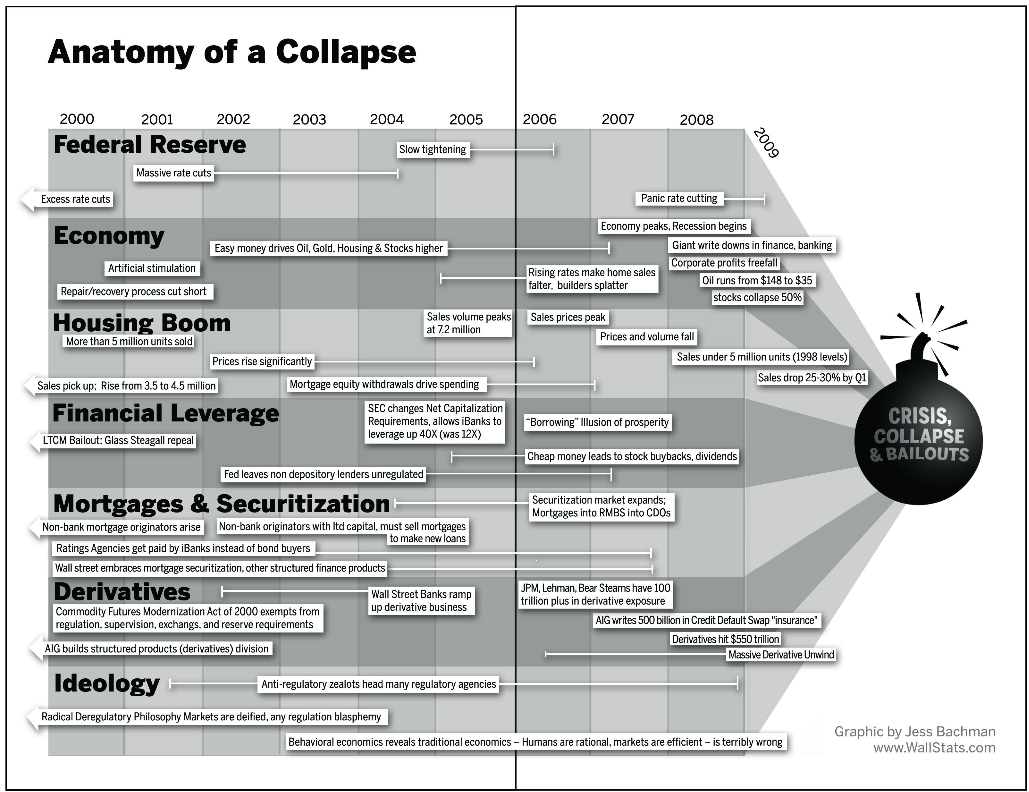
anatomy-of-a-crash
The history of the crash in one Picture
anatomy-of-a-crash.png (PNG Image, 1029x792 pixels) - Scaled (82%)
anatomy-of-a-crash.png (PNG Image, 1029x792 pixels) - Scaled (82%)
Sunday, May 31, 2009


Friday, May 29, 2009
Thursday, May 28, 2009
Saturday, May 23, 2009
FRB: Speech--Bernanke, Commencement address--May 22, 2009
Key thought:
I do not even remember that he spoke at Harvard last year. All I remembered was J.K. Rowling and the gay wizard. Central bankers did not matter in the late spring of 2008.
Key paragraph
So, my advice to you is to stay optimistic. Things usually have a way of working out. My second piece of advice is to be flexible, even adventurous as you begin your careers. As I have tried to illustrate today, you are much less able than you think to foresee how your life, both professional and personal, will play out. The world changes too fast, and too many accidents and unpredictable events occur. It will pay, therefore, to be creative and open-minded as you search for and consider professional opportunities. Look most carefully at those options that will give you a chance to learn new things, explore new areas, and grow as a person. Think of every job as a potential investment in yourself. Will it prepare your mind for the opportunities that chance will provide?
FRB: Speech--Bernanke, Commencement address--May 22, 2009
I do not even remember that he spoke at Harvard last year. All I remembered was J.K. Rowling and the gay wizard. Central bankers did not matter in the late spring of 2008.
Key paragraph
So, my advice to you is to stay optimistic. Things usually have a way of working out. My second piece of advice is to be flexible, even adventurous as you begin your careers. As I have tried to illustrate today, you are much less able than you think to foresee how your life, both professional and personal, will play out. The world changes too fast, and too many accidents and unpredictable events occur. It will pay, therefore, to be creative and open-minded as you search for and consider professional opportunities. Look most carefully at those options that will give you a chance to learn new things, explore new areas, and grow as a person. Think of every job as a potential investment in yourself. Will it prepare your mind for the opportunities that chance will provide?
FRB: Speech--Bernanke, Commencement address--May 22, 2009
Friday, May 22, 2009
Wednesday, May 20, 2009
Economist's View: FRBSF Economic Outlook
San Francisco Fed says that this recovery will be slower than others.
Economist's View: FRBSF Economic Outlook
Economist's View: FRBSF Economic Outlook
Monday, May 18, 2009
The Paradox of Declining Female Happiness"
Some readers have complained that there are too many finance posts. A good gender society post with an economic twist.
A good summary:
And the original paper
Economist's View: "The Paradox of Declining Female Happiness"
And Mankiw's interpretation:
Women's rights movement was a mistake.

A good summary:
And the original paper
Economist's View: "The Paradox of Declining Female Happiness"
And Mankiw's interpretation:
Women's rights movement was a mistake.
Saturday, May 16, 2009
Job Loss
Great graphical display of information: job loss.
An interactive map of vanishing employment across the country. - By Chris Wilson - Slate Magazine
And Bridgewater says that unemployment is now a leading indicator:
Normally, labor markets lag the economy because incremental spending transactions are financed via debt, stimulated by interest rate cuts. But as long as credit remains frozen, spending will require income, and income comes from jobs. And debt service payments are made out of income. Therefore, in a deleveraging environment job growth becomes an important leading, causal indicator of demand and other economic conditions.
“… The bounce in the economy and the stabilization in markets reflect government actions that are big enough to impact near-term growth rates, but are not sufficiently directed at the root problem of excessive indebtedness to produce permanent healing. The deterioration in employment markets will continue because companies’ profit margins are so deeply damaged that a little bounce in growth won’t do much to alter their need to cut costs. This deterioration in labor markets will undermine demand and continue to pressure loan losses, which will keep the pressure on the banks and elevate the cost of capital for tentative borrowers, inhibiting credit expansion.”
An interactive map of vanishing employment across the country. - By Chris Wilson - Slate Magazine
And Bridgewater says that unemployment is now a leading indicator:
Normally, labor markets lag the economy because incremental spending transactions are financed via debt, stimulated by interest rate cuts. But as long as credit remains frozen, spending will require income, and income comes from jobs. And debt service payments are made out of income. Therefore, in a deleveraging environment job growth becomes an important leading, causal indicator of demand and other economic conditions.
“… The bounce in the economy and the stabilization in markets reflect government actions that are big enough to impact near-term growth rates, but are not sufficiently directed at the root problem of excessive indebtedness to produce permanent healing. The deterioration in employment markets will continue because companies’ profit margins are so deeply damaged that a little bounce in growth won’t do much to alter their need to cut costs. This deterioration in labor markets will undermine demand and continue to pressure loan losses, which will keep the pressure on the banks and elevate the cost of capital for tentative borrowers, inhibiting credit expansion.”
Story Time for the Economy
Is it the end of the beginning or the beginning of the end of the downturn.
Khaleej Times Online - Story Time for the Economy
Khaleej Times Online - Story Time for the Economy
Rapt
Rapt
This is a book about secular meditation. Focus on things that foster contentment and not the things that cause worry. As William James said wisdom and a satisfied life is about knowing what to overlook. Our only weapon against stress is to choose one thought over another. Experience depends on what you pay attention to. Remember Rashomon.
The difficulty arises about how to manage one's attention. "It is impossible to communicate with, much less bond with someone you cannot, or will not, focus your attention on."Slow down, focus on relationships, focus on people. Relationships take work.
Try to focus on the small pleasures of everyday life.
Amishi Jha
Posner and Rothbart
Omega Institute for Holistic Studies
This is a book about secular meditation. Focus on things that foster contentment and not the things that cause worry. As William James said wisdom and a satisfied life is about knowing what to overlook. Our only weapon against stress is to choose one thought over another. Experience depends on what you pay attention to. Remember Rashomon.
The difficulty arises about how to manage one's attention. "It is impossible to communicate with, much less bond with someone you cannot, or will not, focus your attention on."Slow down, focus on relationships, focus on people. Relationships take work.
Try to focus on the small pleasures of everyday life.
Amishi Jha
Posner and Rothbart
Omega Institute for Holistic Studies
Thursday, May 14, 2009
Tuesday, May 12, 2009
Sunday, May 03, 2009
Why The Financial System Collapsed
Why it always does: not enough capital in reserve against risky loans.
National Journal Magazine - Why The Financial System Collapsed
National Journal Magazine - Why The Financial System Collapsed
Friday, May 01, 2009
New Home Inventory is droppng
Three reasons:
- Less construction
- Sales of existing inventory
- And this
Calculated Risk: New Homes Demolished in Victorville, CA
- Less construction
- Sales of existing inventory
- And this
Calculated Risk: New Homes Demolished in Victorville, CA
Thursday, April 30, 2009
The real issue with Health Care costs.
We all want expensive care.
THE PRESIDENT: Exactly. And I just recently went through this. I mean, I’ve told this story, maybe not publicly, but when my grandmother got very ill during the campaign, she got cancer; it was determined to be terminal. And about two or three weeks after her diagnosis she fell, broke her hip. It was determined that she might have had a mild stroke, which is what had precipitated the fall.
So now she’s in the hospital, and the doctor says, Look, you’ve got about — maybe you have three months, maybe you have six months, maybe you have nine months to live. Because of the weakness of your heart, if you have an operation on your hip there are certain risks that — you know, your heart can’t take it. On the other hand, if you just sit there with your hip like this, you’re just going to waste away and your quality of life will be terrible.
And she elected to get the hip replacement and was fine for about two weeks after the hip replacement, and then suddenly just — you know, things fell apart.
I don’t know how much that hip replacement cost. I would have paid out of pocket for that hip replacement just because she’s my grandmother. Whether, sort of in the aggregate, society making those decisions to give my grandmother, or everybody else’s aging grandparents or parents, a hip replacement when they’re terminally ill is a sustainable model, is a very difficult question. If somebody told me that my grandmother couldn’t have a hip replacement and she had to lie there in misery in the waning days of her life — that would be pretty upsetting.
And it’s going to be hard for people who don’t have the option of paying for it.
Wednesday, April 29, 2009
China: The Next Great Bubble?
Is China a vendor financing scheme in its last throes or can it stimulate sustainable growth with new investment?
The government is stimulating hard and fast and will not give up easily.
The Next Great Bubble? | The Big Picture
The government is stimulating hard and fast and will not give up easily.
The Next Great Bubble? | The Big Picture
Decline from Peak.
Case Shiller.
What does this mean for NY and Boston. I would suspect there is more downside.
CSselectedCitiesFeb2009.jpg (image)
What does this mean for NY and Boston. I would suspect there is more downside.
CSselectedCitiesFeb2009.jpg (image)
Sunday, April 26, 2009
Can Billions of Parents Be Wrong?,
Yes. Parenting is not only hard, it is ineffective. One answer: boarding school.
Best line: nagging is not cumulative.
Can Billions of Parents Be Wrong?, Bryan Caplan | EconLog | Library of Economics and Liberty
Best line: nagging is not cumulative.
Can Billions of Parents Be Wrong?, Bryan Caplan | EconLog | Library of Economics and Liberty
Luck and Taxes
Thank god we have been lucky.
If nothing else, luck means having the right parents and being born in the right place.
Economist's View: Luck and Taxes
If nothing else, luck means having the right parents and being born in the right place.
Economist's View: Luck and Taxes
Saturday, April 18, 2009
Political Partisanship
New England Republicans were more like New England Democrats than Mississippi Republicans. Now there are no longer any New England Republicans in the House.
EzraKlein Archive | The American Prospect
Also an interesting note on partisanship bias. Republicans liked Bernanke under Bush. They do not like him under Obama. Dems also reversed their views.
EzraKlein Archive | The American Prospect
Also an interesting note on partisanship bias. Republicans liked Bernanke under Bush. They do not like him under Obama. Dems also reversed their views.
Thursday, April 16, 2009
Wednesday, April 15, 2009
Why Health Care Reform is Hard,
American health care is expensive because that is how we want it.
Why Health Care Reform is Hard, Arnold Kling | EconLog | Library of Economics and Liberty
Why Health Care Reform is Hard, Arnold Kling | EconLog | Library of Economics and Liberty
Tuesday, April 14, 2009
Sunday, April 12, 2009
Wednesday, April 08, 2009
Tuesday, April 07, 2009
Predicting the Present with Google Trends
The answer to your question about what Google is going to do with all your data.
Who knew that Google even had a Chief Economist?
Official Google Research Blog: Predicting the Present with Google Trends
Who knew that Google even had a Chief Economist?
Official Google Research Blog: Predicting the Present with Google Trends
Second opinions
Always try to get opinions on big issues from third parties.
Baker suggests second opinions ~ Angry Bear
Baker suggests second opinions ~ Angry Bear
Monday, April 06, 2009
Worse than the Great Depression
You do not often hear this phrase, but the decline in stock prices and trade has been(by some measures) faster.
Economist's View: "A Tale of Two Depressions"
Economist's View: "A Tale of Two Depressions"
Friday, April 03, 2009
Tuesday, March 31, 2009
Monday, March 30, 2009
Saturday, March 28, 2009
Thursday, March 26, 2009
Wednesday, March 25, 2009
Tuesday, March 24, 2009
Monday, March 23, 2009
Saturday, March 21, 2009
Tuesday, March 17, 2009
Calculated Risk: Housing Starts: Is this the Bottom?
Calculated Risk was one of the most prescient on the crisis.
Calculated Risk: Housing Starts: Is this the Bottom?
Calculated Risk: Housing Starts: Is this the Bottom?
Monday, March 16, 2009
Sunday, March 15, 2009
Saturday, March 14, 2009
Land of the Setting Sun
The Land of the Setting Sun
Japan has been in a malaise for 20 years. And just when it looked like the country
might turn around, the bottom has seemingly fallen out. Japan’s economy shrank
a slightly revised 3.2% in the last quarter of last year, confirming the
sharpest contraction since the oil crisis in 1974, and economists warn of
further contraction in the next two quarters.
The Japanese economy, mired in its
worst recession since World War II, is forecast to shrink a further 2.5% in the
first quarter of this year and another 0.4% in the second quarter, a Reuters
poll shows.
But if you look at the underlying
data, it’s even worse. Let’s turn to a recent letter from my good friend and
favorite data maven, Greg Weldon. (www.weldononline.com)
Japanese exports have fallen 54% in
the last 6 months, an average of $40 billion a month, or down over a quarter of
a trillion dollars. Greg notes that past 6-month changes in exports in Japan
were hardly ever up or down more than a trillion yen. This is four times that
level, about 4 trillion yen. To get a visual view, look at the graph below.
That is called falling off a cliff.
The decline in exports is about 45%
year over year. Japan is one of the countries that has run a very large trade
surplus, allowing them to buy lots of dollars and lend a great deal of money.
Their banks have been an engine for growth worldwide, but especially in Asia.
And the graph below shows that trade surplus turning into a large trade deficit
of 952 billion yen, or somewhere over 9 billion dollars.
To give that some perspective, the
US trade deficit came in today and was “only” $36 billion, the lowest level in
six years, mainly due to lower oil prices, as our exports have been shrinking
as well (more on that below). The US economy is roughly three times the size of
Japan’s (and Japan is the world’s second largest economy); so $9 billion is no
small sum of money, relatively speaking.
(Quick note - while looking
for that number on the web, I came across this tidbit in the China Daily. They project that the GDP of
China will surpass Japan’s next year.)
Inventory-to-shipping ratios in
Japan are rising by over 50%, as industrial production is down more than 10%
and likely to fall much further. Japanese auto exports are down 63% in just
four months. Auto exports have literally fallen off a cliff, as inventories
have doubled.
No surprise, Japan is promising
even more government support programs, and aid to industries of all sorts. This
from a government that has over 140% of debt to GDP, about twice that of the
US. And their rapidly rising credit default swap rate is not helping. Who would
have thought of Japan as a credit risk? Three years ago, almost no one. Now,
rates are 30 times higher.
Japan’s economy is driven by
exports. And those exports were crushed as the yen rose in buying power and
Japan’s exports became less competitive in the last quarter, with calls for
intervention to bring the yen back to a level where their industries can be more
competitive. Look at the chart below of the Japanese yen versus the US dollar.
(The moving average is 90 days.)
Note
that less than two years ago the yen was over 124 to the dollar, and fell last
quarter to below 87, and has risen back to 98 today. Think about the Japanese
auto manufacturer. Two years ago he could sell his car in the US (or wherever)
for $30,000 and get 3,750,000 yen. Today, that $30k only gets him a little
under 3,000,000 yen. Think his costs dropped 20%? Think he can raise prices 25%?
If you sell machinery, you are
competing with companies, countries, and currencies all over the world. If your
currency rises, you are less competitive, or your profits have to fall.
Japan has problems, and not just in
manufacturing. The population of the country is now literally shrinking, as
they have the highest proportion of elderly people and the lowest proportion of
children. By 2050, 70% of the labor force will have disappeared. While Toyota
is the world’s largest car company, auto sales in Japan peaked 18 years ago.
Supermarket sales have fallen every year for the last 11 years. This is a
country in a long-term decline, with massive debt. While there is still a lot
of economic power there, it is not the country of the future. Unless they
figure out how to grow their population, it will be a long slow slide.




Friday, March 13, 2009
Tuesday, March 10, 2009
Sunday, March 08, 2009
Just guessing
Any ideas about the size of the hedge fund market.
AllAboutAlpha.com» Today's Post » Reading the divergent hedge fund industry barometers
AllAboutAlpha.com» Today's Post » Reading the divergent hedge fund industry barometers
Saturday, March 07, 2009
Thursday, March 05, 2009
Wednesday, March 04, 2009
Harvard, Private Equity and the Education Bubble - DealBook Blog - NYTimes.com
Are universities just asset management companies with a education department
NY Times on Harvard
Harvard, Private Equity and the Education Bubble - DealBook Blog - NYTimes.com
Forbes
NY Times on Harvard
Harvard, Private Equity and the Education Bubble - DealBook Blog - NYTimes.com
Forbes
Tuesday, March 03, 2009
Vik
Be careful about getting what you wish.
How Citigroup CEO Vikram Pandit Became the Most Powerless Powerful Man on Wall Street -- New York Magazine
How Citigroup CEO Vikram Pandit Became the Most Powerless Powerful Man on Wall Street -- New York Magazine
Monday, March 02, 2009
Japan’s Crisis of the Mind - NYTimes.com
Masaru Tamamoto on the crisis that is Japan.
It is hard to make an argument for long term macro.
Op-Ed Contributor - Japan’s Crisis of the Mind - NYTimes.com
It is hard to make an argument for long term macro.
Op-Ed Contributor - Japan’s Crisis of the Mind - NYTimes.com
Sunday, March 01, 2009
The Budget and Charitable Donations
The deduction for high income earners will be reduced from 35 to 28 percent.
OMB - Blog Post - The Budget and Charitable Donations
OMB - Blog Post - The Budget and Charitable Donations
Saturday, February 28, 2009
First Question
Why wouldn't Faust give her tenure?
Economist's View: Christina Romer Answers Criticisms from Robert Barro and "The Best Man at My Wedding, Greg Mankiw"
Economist's View: Christina Romer Answers Criticisms from Robert Barro and "The Best Man at My Wedding, Greg Mankiw"
Friday, February 27, 2009
Thursday, February 26, 2009


When will house prices bottom?
FDIC says: not yet.
Calculated Risk: Stress Test House Price Scenarios
Look at the gap between new home sales and existing home sales to narrow first.
Calculated Risk: Stress Test House Price Scenarios
Look at the gap between new home sales and existing home sales to narrow first.
Wednesday, February 25, 2009
Killing (or Maiming) a Sacred Cow: Home Mortgage Deductions - Economix Blog - NYTimes.com
Get rid of the Home mortgage deduction. It is regressive and promotes leverage.
Killing (or Maiming) a Sacred Cow: Home Mortgage Deductions - Economix Blog - NYTimes.com
Killing (or Maiming) a Sacred Cow: Home Mortgage Deductions - Economix Blog - NYTimes.com